EPC News

AI in Internal Communication: from fascination to requirement

10.11.2026

Author: Graduate School of Communication

The second edition of the Internal Communications AI Survey, conducted by EPC Austral and Motiva Comunicación Interna, revealed a paradox: efficiency is increasing, but productivity is declining. The results raise new questions about time management and the strategic value of communicators.

Artificial intelligence is already integrated into the workflows of internal communications professionals. However, its adoption is beginning to reveal new challenges: while it allows for increased speed and freed-up time, it also increases the perception of dependence and raises issues related to content quality and creativity.

These were some of the key points of the second edition of the Survey on AI in Internal Communication , a joint initiative of the Master's Program in Communication for Change Management at EPC Austral and Motiva Internal Communication. The presentation of the results, led by Professor Carlos Wirth and Florencia Fragalá , Head of Corporate Communications for Arcos Dorados in Latin America and the Caribbean, discussed how to leverage the potential of these tools without losing a distinctive voice or compromising quality.


Findings 

  • Integration into processes: two out of three people who use AI already integrate it into their processes (it grew from 53% to 66% in one year).
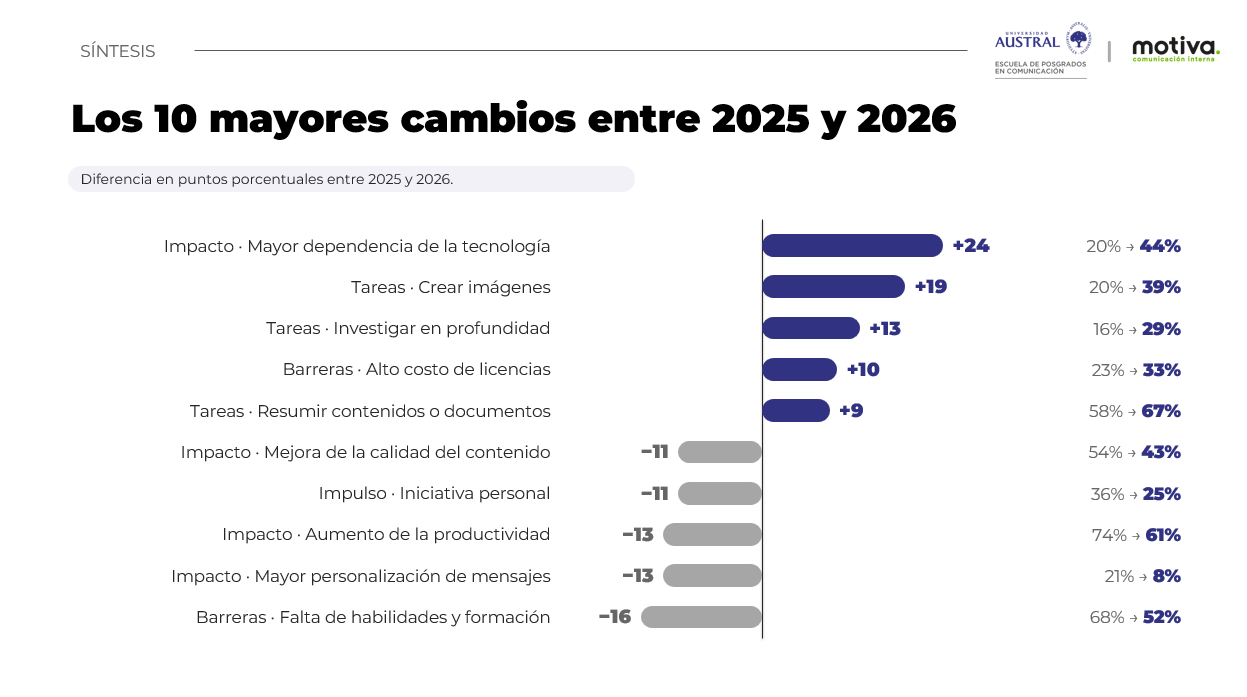
  • Efficiency vs. productivity: Perceived efficiency rises (75% to 84%) and productivity falls (74% to 61%).
  • Increased dependence: the feeling of dependence doubles, going from 20% to 44%.
  • Body impulse: The company's formal strategy becomes the primary impetus, rising from 30% to 39%.

In the words of Carlos Wirth: "The perception is that artificial intelligence is beginning to show its limitations. We gain speed and free up some time, but we are less productive, with lower quality content and less creative. And on the other hand, we feel more dependent."
 

Trends

The use of artificial intelligence is moving towards a more sophisticated stage, transforming the focus of tasks:

  • Evolution of the support: AI is making progress in imaging, analysis, and research. Ideation is taking center stage, while the final stages remain in human hands.
  • Obstacle displacement: The lack of skills is decreasing, but the cost (23% to 33%) and integration (29% to 36%) are increasing.
  • Leap of maturity: Maturity multiplies advanced use; in strategic integration, 46% create agents (vs. 3% in the initial stage).


Challenges

The current scenario poses critical demands for internal communication professionals:

  • Destination of the freed time: Deciding where to go with the freed-up time is key, since 1 in 5 uses it to generate more volume.
  • Taking care of your own voice: to protect the distinctive mark against standardization.
  • Training and governance: Moving from self-learning to organized training and translating general policies into specific policies for CI (which only reach 7%).

At this point, Florencia Fragalá reflected: “What do we do with the time AI saves us? Do we use it to be more efficient, to create more content because I feel more useful, or to generate something new, to put my own voice to the things I do? It’s a change of mindset ; it requires us to step outside our comfort zone. The operational role was the one we had for many years… but now the challenge is to demonstrate the value we have as communicators.”


To access the full report: https://docs.google.com/forms/d/e/1FAIpQLSdY3YHfx3NW4GwZemLmy9tfg0ncNK2yLh5XxFBulduDwaCvug/viewform

It may interest you

10.11.2026

León arrives: an FC A production...
Six video podcasts bring together the voices of specialists...

27.10.2026

Getting to know Pope Leo XIV with the pa...
In a meeting with the University A community...

Share